A Gallery Wall at Home — Composing Multiple Works So They Feel Like an Exhibition
A good gallery wall looks like it happened by itself — but behind every successful picture wall there's a method. A step-by-step guide to building the composition: layouts, spacing, framing, and the right hanging order.
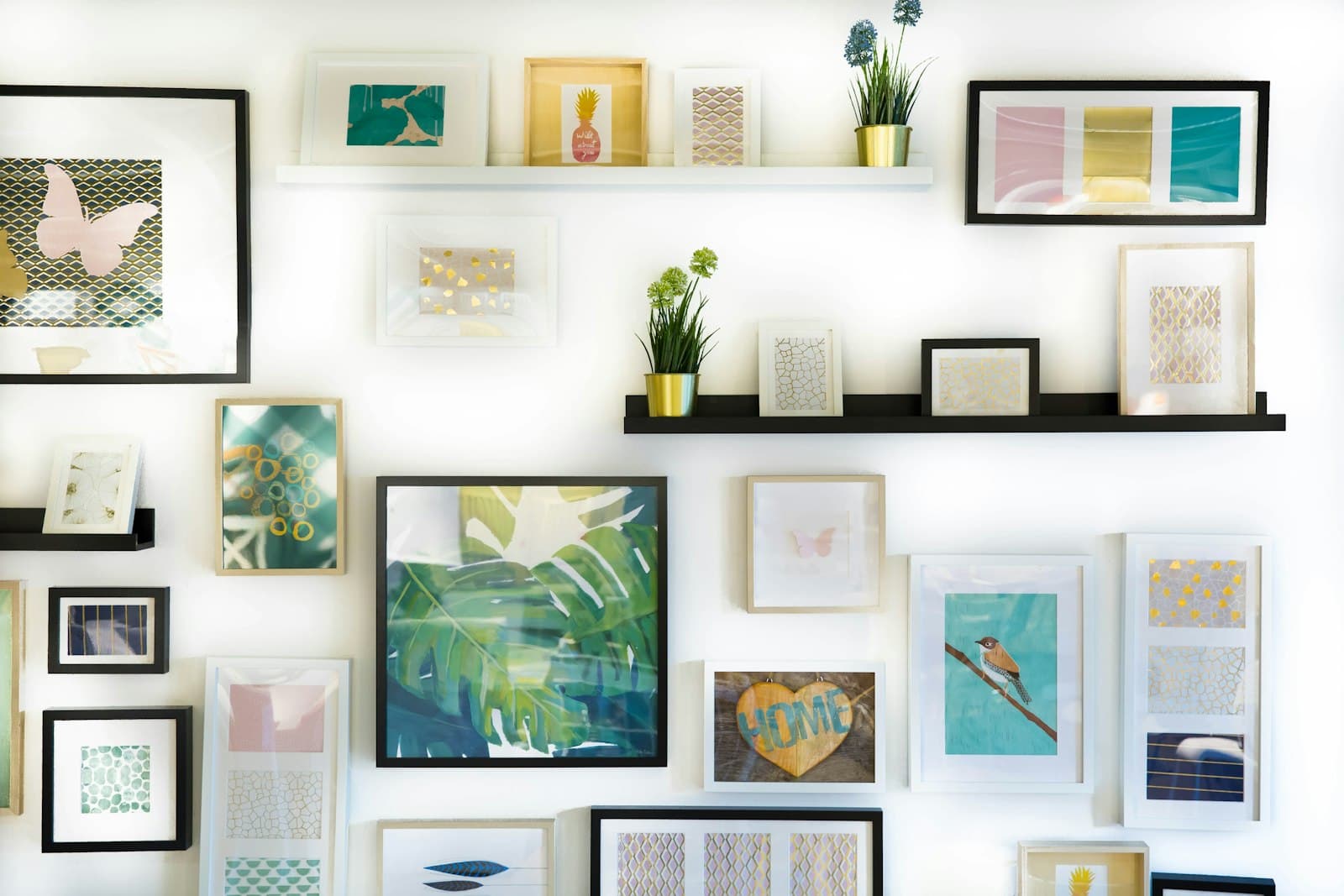
A gallery wall is one of the most satisfying design moves in a home — and one of the riskiest. Done right, it turns an ordinary wall into a personal exhibition that tells visitors who lives here; done wrong, it looks like a bulletin board. The difference between the two isn't talent or luck but method: composition, spacing, and one organizing line.
Before driving a single nail, it's worth grasping the central principle: a successful gallery wall is one artwork made of several parts — not several artworks that happen to hang close together. Every decision in this guide follows from that principle.
Step One: Choose a Connecting Thread
The collection needs at least one strong common denominator: a color palette (say, all works in earth tones), a technique (only line drawings, only black-and-white photography), a subject (landscapes, portraits, botanicals) or uniform framing. Two common denominators are excellent; zero gets you noise. The easiest path to success: vary the sizes and compositions, but keep one color family and consistent framing.
Step Two: Choose a Layout
- Grid: identical sizes, equal spacing. A museum-precise look, excellent for print sets and hallways.
- Salon: mixed sizes aligned around an imaginary horizontal axis at 145 cm. The most forgiving and lively layout.
- Central anchor: one large work at the center with smaller pieces around it. Works beautifully above a sofa or sideboard.
- One aligned edge: a straight bottom line (above a console, for example) with free heights above it — order and freshness together.
Spacing is the designers' best-kept secret: 5 to 8 cm between works, and consistent across the whole wall. Uneven gaps are the number-one reason a home picture wall looks 'almost right but something's off'. Commit to one fixed gap and the composition tightens immediately.
Step Three: Lay It Out on the Floor, Not the Wall
Build the composition on the floor in front of the wall, shifting and swapping until the eye settles. Then cut newspaper or kraft-paper templates the size of each work and tape them to the wall following the layout. Live with the templates for a day or two — only then drill. An hour of patience saves ten unnecessary holes.
A good gallery wall isn't a collection of works you love. It's one work you build from them.
How Many Works, and Where to Find Them
Start with five to seven works — enough to create presence, few enough to control the result. A gallery wall is a living organism: leave it room to grow, and add a new piece every few months. The wall becomes a visual diary of the home rather than a one-off project.
And if you're missing 'the connecting piece' — the one that closes the palette or fills the gap in the composition — that's exactly the scenario where a custom commission beats endless shop-hunting. Many clients open a brief on walll.art with a photo of their existing gallery wall, and artists submit proposals designed in advance to belong in it: the same color family, an exact size for the gap in the layout, and a spirit that continues and enriches the collection.
One more principle worth borrowing from the gallery world: not everything on the wall has to be a framed artwork. A narrow picture ledge, a painted tile, framed textile or a paper work — one exceptional item gives the wall depth and rhythm, as long as it obeys the connecting thread.
Questions & answers — Guides
How many pictures does a gallery wall need?
Start with five to seven works — enough to create presence while staying easy to control. A good gallery wall is built gradually: leave room to grow and add a piece every few months, so the wall evolves with the home.
What is the correct spacing between pictures on a gallery wall?
Between 5 and 8 cm from work to work, kept consistent across the wall. Uneven gaps are the most common mistake on home picture walls — one fixed gap immediately tightens the composition.
How do you make different pictures look like one set?
Choose at least one connecting thread: a shared color palette, a uniform technique, a recurring subject or identical framing. The safe route: vary the sizes but keep one color family and consistent frames.
At what height should a gallery wall hang?
Organize the composition around an imaginary horizontal axis 145 cm from the floor — average eye level. Above furniture, the lowest work should sit 15–25 cm above the furniture line.
How do you plan a gallery wall without drilling unnecessary holes?
Build the layout on the floor, cut paper templates the size of each work and tape them to the wall. Live with the templates for a day or two, adjust what's needed — and only then drill.
Can I commission a piece to fit an existing gallery wall?
Yes — it's one of the strongest uses of a custom commission. Upload a photo of the existing wall to your brief and note the palette and the missing size; artists submit proposals designed to belong in the collection, and you see each one visualized on the wall before choosing.